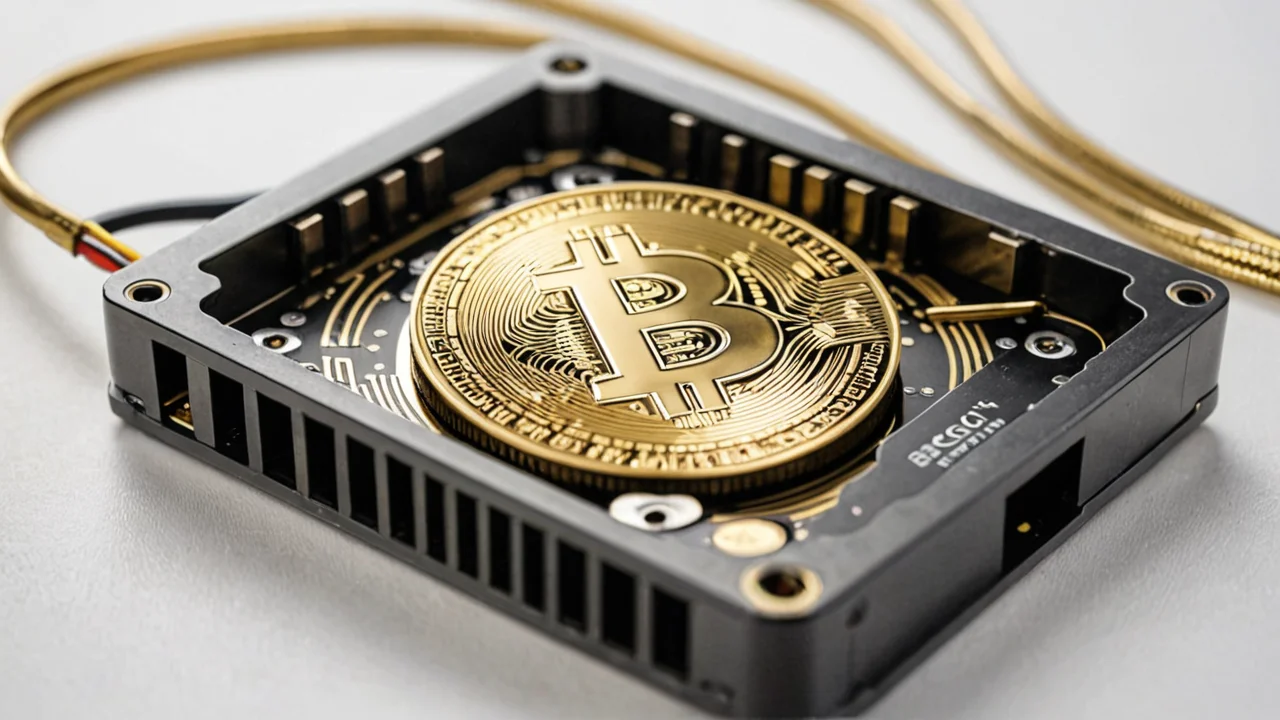
Bitcoin is a peer-to-peer electronic cash system with a fixed supply cap of 21,000,000 BTC, no issuing authority, and no government or central bank backing it, according to the U.S. Commodity Futures Trading Commission. Everything else a beginner needs — how transactions settle, how price is set, how it's taxed and regulated, how to hold it safely — follows from those three properties. The rest of this page is about what those properties cost you in practice.
What actually happens when you send bitcoin
A bitcoin transaction is a signed instruction that spends a specific chunk of bitcoin to one or more new addresses, and it isn't final until a miner includes it in a block. The network targets 10 minutes between blocks by protocol design, but that's an average across the whole network, not a promise about your payment. Blocks arrive in clusters; you can wait an hour and then see three confirmations in twenty minutes. This is why merchants and exchanges treat confirmation count as a risk dial rather than a fixed rule — one confirmation for a coffee, several for a car, more for anything irreversible.
The mechanism underneath is proof-of-work. Miners compete to find a cryptographic nonce that makes a block's hash fall under a network-wide difficulty target, which demonstrates real computational work was spent before anyone accepts the block. Each block contains a batch of transactions and references the previous block's hash, producing a distributed, append-only ledger — the blockchain — that is tamper-evident rather than tamper-proof in some absolute sense. Altering an old block means redoing the work on it and every block after it, which is why depth matters.
What this buys you: settlement without an intermediary, on a schedule nobody controls, with a supply schedule nobody can vote to change. What it costs you: throughput. Bitcoin's base layer is deliberately expensive per transaction, and the fee you pay is bid for scarce block space. When demand spikes, fees spike, and small payments stop making sense. You'll notice this as a wallet quoting a fee that exceeds the amount you're trying to move. The honest answer at that point is to wait, or to use a layer built on top rather than the base chain.
The design intent is explicit. The 2008 whitepaper, released October 31 under the pseudonym Satoshi Nakamoto to a cryptography mailing list, is titled "Bitcoin: A Peer-to-Peer Electronic Cash System" and describes online payments sent directly from one party to another without going through a financial institution. That's the whole thesis. Everything the protocol does — the block interval, the difficulty adjustment, the supply cap — serves that goal, and the trade-offs are the price of it.
Why 21 million is a design choice, not a discovery
The 21,000,000 BTC cap is written into the protocol and enforced by every node that validates blocks; a miner that tried to issue more would produce blocks the rest of the network rejects. New bitcoin enters circulation only as the block reward, which is cut on a fixed schedule, plus transaction fees. The cap is fixed at the protocol level and has held since launch.
What this means for a holder is narrower than the marketing suggests. Scarcity is a property of the issuance schedule; it says nothing about demand, and price is set entirely by what buyers and sellers agree to. It also doesn't mean the price can't fall by most of its value — an asset with a fixed supply and volatile demand is a volatile asset. The CFTC is explicit on the related point: virtual currencies are not backed or supported by any government or central bank, even though they can be exchanged for U.S. dollars or other currencies. There is no issuer standing behind the price.
The practical consequence is that bitcoin behaves like a risk asset with a hard cap, not like a savings account. Position sizing is the decision that matters most, and it's the one people spend the least time on. A useful test: if a large drawdown would force you to sell, the position is too big regardless of how sound the supply schedule is.
Where the price you see actually comes from
There is no single official bitcoin price. Different venues print different numbers at the same moment, and the gap widens exactly when you care most — during fast moves, on weekends, around outages. For anything that needs one defensible number, the reference is the CME CF Bitcoin Reference Rate, a daily benchmark of the U.S. dollar price of one bitcoin as of 4:00 p.m. London time, computed from trade data over the preceding one-hour observation window. Under the 2020 methodology, that window runs from 3:00 p.m. to 4:00 p.m. London time and is split into 12 equally sized partitions of 5 minutes each, so a single wild print in one venue can't drag the whole rate.
That structure is worth understanding even if you never touch a futures contract, because it tells you what a "real" price is: a time-averaged, multi-venue figure, not the last trade on whichever exchange your app happens to use. If you're doing anything that references a price at a specific time — settling a contract, converting for accounting, valuing a treasury — you want a benchmark of that shape, not a screenshot.
The limit: a daily benchmark is useless for execution. If you're actually buying or selling, you're taking a spot price at a moment, paying a spread, and possibly a fee. The gap between the benchmark and your fill is a real cost, and on smaller venues it's larger than beginners expect. Check the spread before you check the chart.
How it's classified, and why that decides your tax form
In the United States, bitcoin is a commodity. The CFTC states that Bitcoin and other virtual currencies have been determined to be commodities under the Commodity Exchange Act, which gives the agency anti-fraud and anti-manipulation authority over virtual currency cash markets. That classification shapes who polices what: the CFTC's role is policing fraud and manipulation, not guaranteeing returns or safety, and it warns that virtual currency trading carries unique risks.
Two misconceptions are worth killing here. First, commodity status does not make bitcoin a risk-free investment — the CFTC is explicit that it doesn't. Second, commodity status is not the same as currency status. Legal tender is determined country by country. An IMF report notes that El Salvador became the first country to adopt Bitcoin as legal tender alongside the U.S. dollar, mandating acceptance for goods and services with automatic conversion to dollars through a trust fund, which left the country with 2 legal tender currencies after the 2021 Bitcoin law. That's one country's choice, not a global status. Nothing about it changes how a U.S. taxpayer reports a sale.
For a U.S. reader the operative fact is that buying, selling, swapping, and in most cases spending bitcoin are taxable events, and the reporting burden falls on you, not on an exchange that may not even send you a form. The record-keeping decision comes before the investment decision, because reconstructing basis after the fact is miserable. Export your transaction history to a spreadsheet on a schedule — monthly is not too often — with date, amount, price at the time, and fee. The cost of doing this is a few minutes a month; the cost of not doing it is a weekend with a tax preparer and whatever they charge.
Mining, energy, and what the numbers do and don't say
Bitcoin mining is the process of performing proof-of-work to validate and record transactions into blocks, earning newly created bitcoin and transaction fees according to the protocol's rules. It converts electricity into security, and the security budget is the reason the ledger is expensive to rewrite. That framing matters because most energy arguments skip it: the consumption isn't overhead, it's the product.
The magnitudes people cite are often out of date or misread. An illustrative academic tool estimate put Bitcoin at 0.21% of the world's electricity supply and an instantaneous load of 7 gigawatts, both as of 2019. Cambridge's model estimates a 59.4% low-carbon energy share as of December 2025. Treat these as estimates from named models, not measurements — the sourcing and assumptions differ, and a figure from 2019 should not be quoted as current.
For an individual, mining is a capital and operations business, not a hobby with a payoff. You're competing against operators with cheap power contracts and purpose-built hardware, and your rig's profitability moves with the hashprice and the difficulty adjustment. The failure mode is familiar: buy hardware at a high bitcoin price, watch difficulty rise, watch the machine fall below breakeven, keep running it out of sunk-cost reasoning. If you want exposure to bitcoin, buying it is simpler and has a known cost. Mining is a bet on your electricity rate and your operational competence, and it's the wrong choice for most people who just want the asset.
Holding it: the decisions that actually cost you money
The dominant risk in holding bitcoin is not price. It's losing access. Bitcoin has no customer service line, no chargeback, and no password reset. A confirmed transfer to an address you don't control is gone, and a seed phrase you didn't back up is the same as a seed phrase you lost. The single most consequential decision a beginner makes is custody, and it's usually made badly — in a hurry, on an exchange, because that's where the purchase happened.
There are three broad models, and each has a real cost:
- Exchange or broker custody. Easiest, and appropriate for small amounts you intend to sell soon. You're relying on a counterparty's solvency and security, and withdrawals can be paused exactly when you want them. Not your keys, not your coins is a cliché because it keeps being true.
- Self-custody with a hardware wallet. You hold the keys; you also hold the entire burden. A hardware wallet costs money, requires a genuine device bought from the manufacturer rather than a marketplace, and demands that you write the seed phrase on paper or metal and store it somewhere that survives fire and flood but isn't obvious. Test your backup by recovering the wallet before you move meaningful funds to it. The common failure is a backup that was never verified.
- Multisignature or collaborative custody. Splits the key across devices or a provider so no single loss is fatal. More robust, meaningfully more complex, and the setup is where people make mistakes. Worth it above a certain size, overkill below it.
The trade-off is symmetric and honest: self-custody removes counterparty risk and adds personal-error risk. The question isn't which risk is worse in the abstract; it's which one you're actually equipped to manage. Someone who travels constantly, shares a home, or knows they'll forget a passphrase may be safer on a regulated custodian, and that's a legitimate answer. Someone holding a long-term position on an exchange indefinitely is taking a risk they may not have priced.
Whatever you choose, write down the sequence before you move funds: buy, wait for the withdrawal to clear, send a small test amount to the new address, confirm it arrives, then send the rest. Check the first and last characters of the address on both screens, because clipboard malware swaps addresses and the result looks identical at a glance. The cost of a test transaction is a fee; the cost of skipping it is the balance.
The order to make these decisions in
Decide why you're holding before you decide how. The answers diverge sharply: a short-term trade belongs on a liquid venue with tight spreads, where you'll pay fees and accept counterparty risk knowingly; a long-term position belongs in self-custody, where you'll pay in setup effort and operational discipline. Mixing the two — trading out of cold storage, or parking a long-term position on an exchange for convenience — is where most avoidable losses originate.
Then sequence the rest. Confirm your jurisdiction's tax treatment and start the record-keeping before your first purchase, because basis is easiest to capture at the moment of acquisition. Choose a custody model you can actually operate, and test it with a small amount. Size the position so a severe drawdown doesn't force a sale. Learn to read a fee estimate and a benchmark price so you know what you're paying and what you're being quoted. Only then worry about the chart.
None of this makes bitcoin safe. The CFTC's warning that virtual currency trading carries unique risks is the accurate summary, and nothing in the protocol's design contradicts it. What the design does give you is a predictable issuance schedule, a settlement layer that runs on a 10-minute target without an intermediary, and a public ledger anyone can audit. Those are real properties. They're also not a plan — the plan is the part you write.